Supreme Court Clarifies LMV License Covers Commercial Vehicles Under 7.5 Tons
By Amit Jangra | Published Date : July 26, 2025
Supreme Court confirms LMV license holders can drive commercial vehicles under 7.5 tons, offering relief to small truck drivers.
A recent Supreme Court judgment has cleared up confusion many drivers and vehicle owners had about licenses. A Light Motor Vehicle licence holder can drive commercial trucks or 7.5 tonnes of weight vehicles as per court orders. The popular truck models in this category are Tata 407, pickup trucks and other mini trucks.
What the Ruling Means
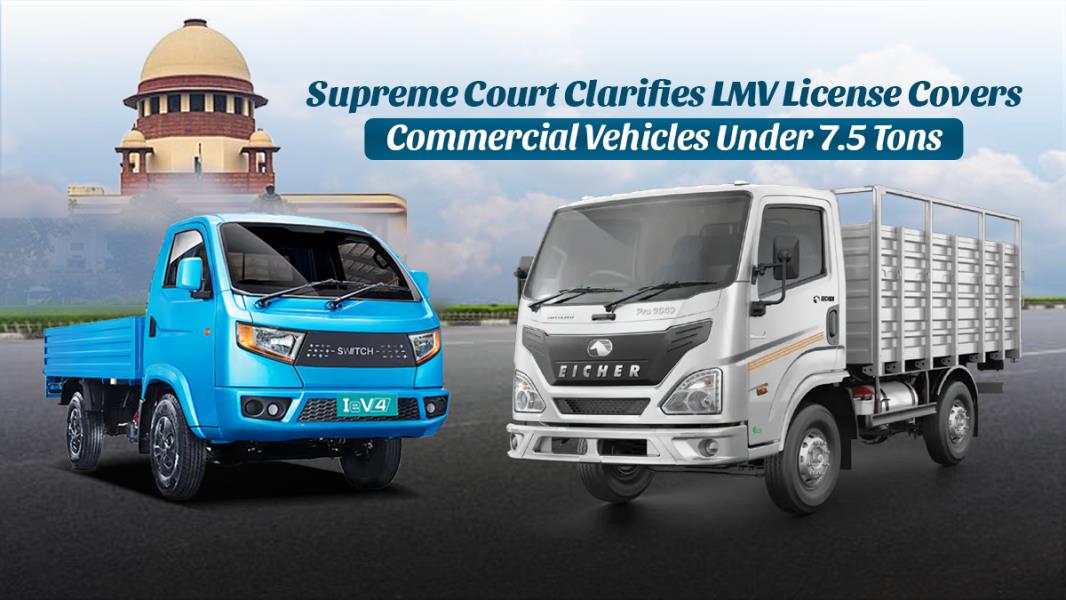
Table of Contents
| 1. What the Ruling Means |
| 2. Why the Issue Came Up Again |
| 3. What's Next? |
| 4. Social Impact and Livelihood Concerns |
| 5. What Happens Next? |
| 6. Final Words |
You Might Like: Piaggio has Launched New Apé E-City Ultra and FX Maxx Electric 3-wheeler in India
The main issue was straightforward: Can a person with an LMV license legally drive a commercial vehicle such as a Tata Ace or Ashok Leyland Dost, as long as it stays under the weight limit?
The judges said yes. If a transport vehicle is under 7.5 tons (unladen), then it still counts as a light motor vehicle — even if it's used for business or delivery work. That means drivers don’t need to get a separate “transport” license just to continue working with these vehicles.
This is a major relief for people in the logistics, agriculture and e-commerce sectors — many of whom use small trucks to earn a daily living. From gig workers to rural vendors, this decision protects a large part of the working population who were at risk of losing legal driving status.
Why the Issue Came Up Again
Back in 2017, the Court had ruled in the Mukund Dewangan case that LMV licenses covered commercial vehicles below 7,500 kg. But in 2022, a three-judge bench asked for a fresh look at that verdict. They pointed out that parts of the Motor Vehicles Act (MVA), 1988, might have been misinterpreted — particularly the difference between “LMV” and “transport vehicle” categories.
Insurance companies also got involved, arguing that commercial and LMV licenses are not identical. They pointed out that:
→ An LMV license is typically issued at age 18 and is valid for up to 20 years.
→ A transport license has stricter requirements, including age limits and periodic renewals.
What's Next?
While this ruling clears things up for now, the Court made it clear that it's not responsible for setting long-term policy. Instead, it has asked the Ministry of Road Transport and Highways to come up with a licensing system that works in today’s context — one that reflects the fast-changing nature of work, including gig jobs and last-mile delivery roles.
Social Impact and Livelihood Concerns
Chief Justice D.Y. Chandrachud highlighted that overturning the Dewangan judgment could have serious consequences for thousands of drivers across India. Many of these drivers either own their mini trucks or lease them to make a living — delivering goods for e-commerce platforms, transporting produce from farms, or working in local transport and logistics.
Mr. D.Y. Chandrachud strictly ordered them to focus on the real-world impacts of their decision. He told them that they can't dismiss all drivers who have been legally driving trucks for years at a moment's notice.”
What Happens Next?
The central government has already said it's planning to make some changes to the Motor Vehicles Act to clear up confusion around LMV licenses. One idea that’s being discussed is to split LMV licenses into two types — one for personal use (LMV-1) and another for driving commercial vehicles (LMV-2).
That said, lawmaking takes time. And rather than wait for new rules to be passed, the Supreme Court went ahead and gave its decision. So, for now, anyone with a standard LMV license can still legally drive light commercial vehicles that weigh under 7.5 tonnes — whether it’s a mini truck, a small goods carrier, or a farm transport vehicle.
This is important for countless drivers across the country — from delivery agents working in cities to farmers and shopkeepers transporting goods in rural areas. It means they don’t have to worry about suddenly being told they’re not licensed to do their job.
Final Words
This ruling finally clears up a lot of confusion. For years, the rules around driving light commercial vehicles were vague and both drivers and insurers were stuck in grey areas. With this judgment, there’s now a clear, fair system in place.
It’s not just about paperwork—it’s about creating a safer, more responsible transport environment across the country. And for thousands of small businesses and daily wage drivers, it’s a big step in the right direction.
Also Read - Delhi Extends Electric Vehicle Policy Until March 2026 for Public Consultation
Join us for latest updates on Truck Industry -
⇒ Facebook - https://bit.ly/TrucksBusesFB
⇒ Instagram - https://bit.ly/TrucksBusesInsta
⇒ YouTube - https://bit.ly/TrucksBusesYoutube
⇒ Twitter - https://bit.ly/TrucksBusesX
⇒ Linkedin - https://bit.ly/TrucksBusesLinkedin
Frequently Asked Questions on Trucks
1. Can an LMV license holder legally drive a commercial vehicle under 7.5 tons?
Ans: Yes. The Supreme Court has confirmed that an LMV (Light Motor Vehicle) license is valid for driving commercial vehicles under 7.5 tons.
2. Does this ruling apply to vehicles like Tata 407, Tata Ace, and pickup trucks?
Ans: Yes. Vehicles such as Tata 407, Tata Ace, and other small goods carriers fall under the 7.5-ton limit and can be driven with an LMV license.
3. Is a separate transport license still required for these vehicles?
Ans: No. As per the Court’s ruling, no separate transport license is required for driving commercial vehicles under 7.5 tons.
About the Author

Amit Jangra
Amit Jangra is a dedicated content writer at TrucksBuses.com, a leading Indian portal for commercial vehicle insights. With a strong background in social work and a passion for the transportation sector, Amit brings a unique perspective to his writing. His articles are known for their clarity and depth, making complex topics accessible to a broad audience. Amit's commitment to empowering readers through informative content reflects his broader mission of societal upliftment.