TVS Predicts Major EV Shift in L5 Segment by 2030
By Jony Shekhawat | Published Date : August 26, 2025
TVS expects 60% of L5 cargo vehicles to be electric by 2030.
Chennai, August 2025, TVS Motor Company predicts a groundbreaking shift in India’s L5 three-wheeler market, expecting that by the end of this decade, 60% of all L5 three-wheelers will be electric, a massive leap from the current 23% EV share.
A New Chapter in Commercial Mobility
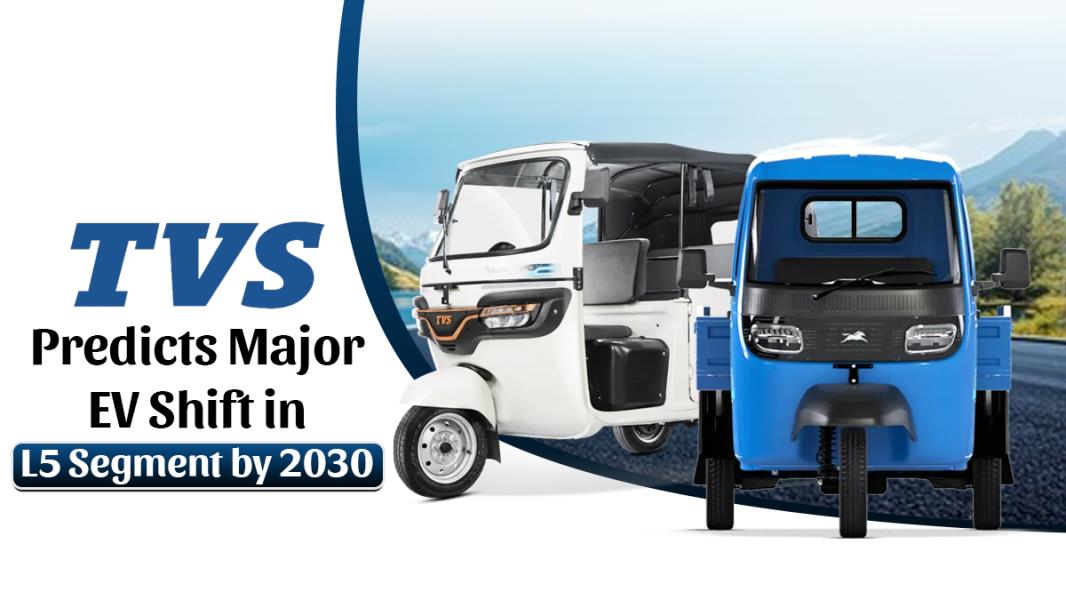
Table Of Contents
| 1. A New Chapter in Commercial Mobility |
| 2. Strong Start for EVs in FY2025 |
| 3. Why EVs Are Gaining Ground: Cost and Convenience |
| 4. TVS’s Electric Cargo Entry and the Broader Strategy |
| 5. Backed by Policy Support |
| 6. Why This Matters for the Commercial Three-Wheeler Landscape |
| 7. Conclusion |
TVS Motor’s optimism is driven by growing urban mobility needs and the appeal of lower total cost of ownership, especially for those using these vehicles for daily operations. “The overall market will continue to grow. We expect that by 2030, around 60% of the market will be made up of electric 3-wheelers,” said Rajat Gupta, who leads commercial mobility at TVS Motor.
Strong Start for EVs in FY2025
In the financial year 2024–25, India saw 1.6 lakh (160,000) electric L5 three-wheelers sold out of an estimated total of 7.2 lakh units, marking an EV share of approximately 23%. The passenger segment continues to lead, accounting for over 80% of sales.
Why EVs Are Gaining Ground: Cost and Convenience
Research from JMK reveals the L5 electric three-wheeler segment grew at an extraordinary CAGR of 193.6% between FY2023 and FY2025. A key reason? EVs cost significantly less to run, around Rs 0.50 to Rs 0.70 per km, compared to Rs 3–4 per km for ICE models. With daily usage of 8–12 hours, fleet operators can recover their investment in just 12–18 months.
Leading the charge is Mahindra Last Mile Mobility, which sold 52,246 electric L5 units in FY2025, with over 90% of its L5 range electric. Bajaj Auto followed with 46,118 units, though EVs formed only 12% of its total L5 sales. TVS sold 1,696 electric units, making up 7% of its L5 business.
OEMs, including Piaggio and Omega Seiki, are stepping up with innovative solutions, like battery-swapping models and urban-focused designs. Fleet operators, including Uber and Rapido, are also pushing electrification forward.
TVS’s Electric Cargo Entry and the Broader Strategy
This month, TVS launched its first electric L5 payload vehicle, the King Kargo HD EV, designed for urban and semi-urban logistics after Kargo King. It will debut in key markets like Delhi NCR, Bengaluru, and parts of Rajasthan.
In the passenger EV space, TVS introduced the King EV Max in Kolkata earlier this year at around Rs 2.95 lakh. This vehicle offers a 179 km range, fast charging (80% in 2 hours and 15 minutes), and smart connected features.
Backed by Policy Support
Government schemes such as PM E‑Drive (formerly EMPS/FAME) and the Production-Linked Incentive (PLI) program continue to bolster EV adoption by providing subsidies of Rs 2,500 per kWh, capped at Rs 25,000 per vehicle. These incentives are currently vital in lowering upfront costs and encouraging purchases.
Why This Matters for the Commercial Three-Wheeler Landscape
Fast EV Growth: A leap from 23% to a projected 60% EV share in the L5 segment by 2030 marks a significant transformation.
Cost Efficiency Wins: Operators stand to save significantly on operating costs, making electrification a financially smart move.
TVS Steps Up: With both passenger and cargo EVs in the pipeline, TVS is positioning itself strongly in urban mobility.
Supportive Ecosystem: Favorable policies, fleet demand, and evolving infrastructure are accelerating the shift.
Conclusion
The latest electric 3-wheeler market is growing rapidly nowadays. Although EV vehicles are becoming a great necessity for the future. These are cost-effective, fuel-efficient, and smart vehicles in place of traditionally fueled vehicles. Now, TVS Motors is trying to launch new electric 3-wheelers and may become the top position in the near future.
Related News:
July Sees Stable Truck Rental Prices as Festive Season Approaches
Powerful 3 Models of Tata Ace Pro: Which One Will You Choose?
Join us for the latest updates on the Truck Industry -
Facebook- https://bit.ly/TrucksBusesFB
Instagram- https://bit.ly/TrucksBusesInsta
YouTube- https://bit.ly/TrucksBusesYoutube
Twitter- https://bit.ly/TrucksBusesX
LinkedIn- https://bit.ly/TrucksBusesLinkedin
Frequently Asked Questions on New TVS 3-Wheelers
Q1: What is the L5 segment?
Ans: It refers to three-wheeled vehicles used mainly for cargo transport in urban and semi-urban areas.
Q2: Why is TVS focusing on electric three-wheelers?
Ans: To meet the rising demand for clean, cost-effective last-mile delivery solutions in cities.
Q3: What share of the market does TVS expect to go electric by 2030?
Ans: Around 60% of the L5 cargo vehicle market.
Q4: How will this impact urban logistics?
Ans: It will reduce emissions, cut operating costs, and support sustainable delivery systems.
Q5: Has TVS launched electric cargo vehicles?
Ans: Yes, TVS has entered the electric three-wheeler cargo segment to meet growing demand.
About the Author

Jony Shekhawat
Jony Shekhawat is a skilled content writer at TrucksBuses.com, one of India’s top platforms for commercial vehicle news and reviews. With roots in social work and a keen interest in the logistics and mobility space, Jony crafts content that is both insightful and easy to understand. He specializes in breaking down complex commercial vehicle trends, helping readers make informed decisions. His writing not only informs but also aims to support the growth of India's transport community through knowledge and awareness.