Tata Motors Sees Growth in Sales and Market Share During FY26
By Amit Jangra | Published Date : June 07, 2026
Tata Motors reported strong FY26 results with higher sales, improved market share and a 72.3% ROCE, despite global economic challenges.
The year brought both opportunities and challenges for Tata Motors. Even when market conditions became uncertain, the company continued its operations and ended FY26 with good results, according to Chairman N Chandrasekaran. Trade-related issues affected global markets and later another crisis in West Asia created fresh uncertainty. Even then, business activities continued and many companies adjusted themselves according to the changing situation. In India too, different steps were taken to support economic growth and consumer spending. This helped several industries during the second half of the year.
Revenue and Profit Numbers Improve
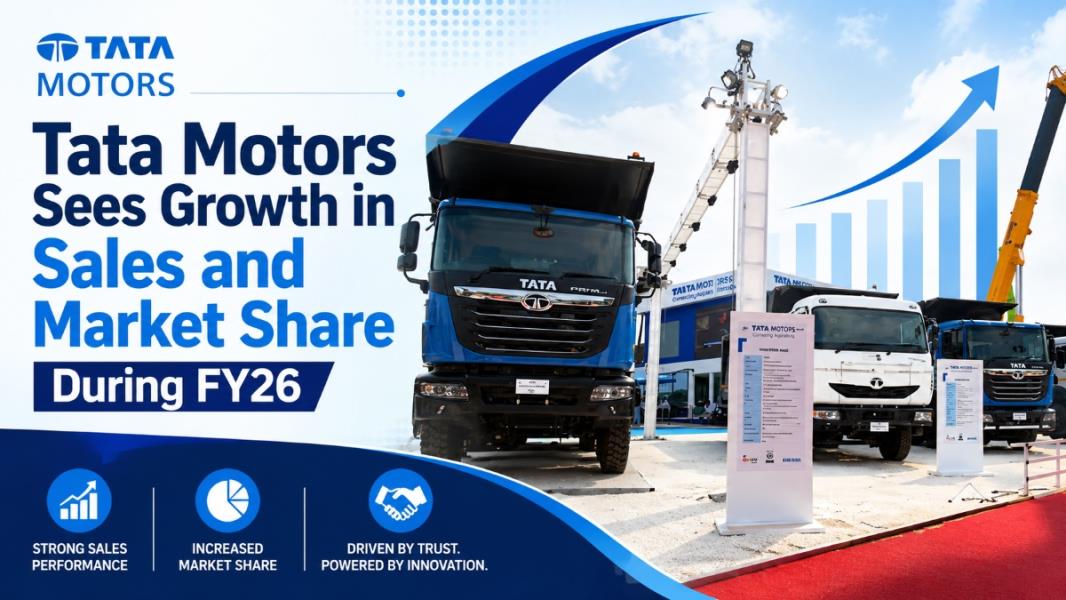
Table of Contents
| 1. Revenue and Profit Numbers Improve |
| 2. Sales Growth Seen Across Different Segments |
| 3. Company Tries a Different Approach |
| 4. Focus on Global Expansion |
| 5. Plans for the Years Ahead |
►Read More: Ultra Gas & Energy Eyes Expansion of LNG Refuelling Network
During FY26, Tata Motors reported revenue of ₹83,855 crore, which was higher than the previous year. The company also improved its operating performance and recorded better margins. One figure that received a lot of attention was the Return on Capital Employed, or ROCE. According to the company, it reached 72.3 percent during the year. While most customers may not look at financial ratios every day, such numbers are often used to understand how efficiently a company is using its resources. N Chandrasekaran said this level of performance puts Tata Motors among the stronger commercial vehicle companies globally.
Sales Growth Seen Across Different Segments
The company also sold more vehicles compared to last year. Total sales crossed 4.35 lakh units during FY26. Growth was seen in different categories. Small commercial vehicles performed well and there was improvement in medium-duty and light-duty vehicle segments too. The heavy commercial vehicle business also had a positive year. Market share in this segment reached its highest level in almost ten years. Many transport companies continue using Tata trucks for goods movement across highways and industrial routes. This helped the company maintain a strong position in the market.
Company Tries a Different Approach
One change made by Tata Motors during the year was dividing the business into separate verticals. The idea was simple. If one area faces slow demand, other businesses can continue supporting overall growth. The company said this approach helped non-vehicle businesses such as spare parts and services grow at a faster pace. People in the transport industry often say that vehicle sales can go up and down depending on market conditions. Because of this, having income from multiple sources is generally seen as a useful strategy.
Focus on Global Expansion
Another major announcement during the year was the proposed acquisition of IVECO Group. If the deal moves ahead, Tata Motors will gain a stronger presence in Europe and Latin America. The acquisition is also expected to add a large number of vehicle sales to the company's overall business. Apart from market reach, the company is also interested in technology that could be useful in the future as emission standards become stricter.
Plans for the Years Ahead
Tata Motors says there is still a lot of work to do in the years ahead. The company is continuing with electric vehicle projects and is also studying hydrogen-based transport options. According to N Chandrasekaran, the focus remains on making products that people and businesses can use easily. He said FY26 brought some good results, but it was also a year in which the company prepared itself for the next stage of growth.
► You Might Like: Daimler Truck Brings Electric Lowliner To Market
Frequently Asked Questions on Commercial Vehicle
1. How many vehicles did Tata Motors sell in FY26?
Ans: Tata Motors sold more than 4.35 lakh vehicles during FY26, showing growth compared to the previous year.
2. What was Tata Motors' ROCE in FY26?
Ans: The company reported a Return on Capital Employed (ROCE) of 72.3% during FY26.
3. Which segment performed well for Tata Motors in FY26?
Ans: Small commercial vehicles, medium and light commercial vehicles and the heavy commercial vehicle segment all contributed to growth.
4. What are Tata Motors' future plans?
Ans: Tata Motors plans to continue working on electric vehicles, hydrogen-based technologies and expanding its global presence.
Join us for the latest updates on the Truck Industry -
☞ 
 Facebook
☞  Instagram
☞  YouTube
☞  Twitter
☞  LinkedIn
☞  Threads

About the Author

Amit Jangra
Amit Jangra is a dedicated content writer at TrucksBuses.com, a leading Indian portal for commercial vehicle insights. With a strong background in social work and a passion for the transportation sector, Amit brings a unique perspective to his writing. His articles are known for their clarity and depth, making complex topics accessible to a broad audience. Amit's commitment to empowering readers through informative content reflects his broader mission of societal upliftment.