Tata Technologies Brings Back InnoVent With A Focus On Edge AI Solutions
By Jony Shekhawat | Published Date : June 05, 2026
Tata Technologies has launched the fourth edition of InnoVent-27 in partnership with AWS and Emerson, giving engineering students a chance to build Edge AI solutions for real-world industrial applications.
Engineering students often complain that college projects rarely match the kind of problems industries deal with every day. Tata Technologies is trying to change that, at least for a few students, through the latest edition of its InnoVent hackathon. The company has officially opened registrations for InnoVent-27, which is now in its fourth year.
Edge AI Becomes The Main Theme
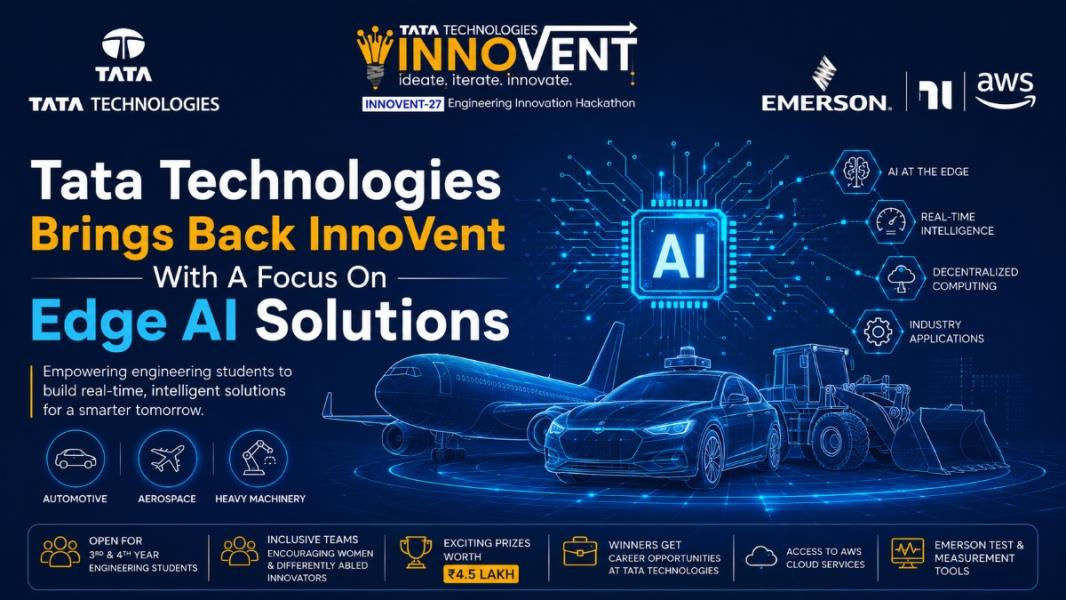
Table of Contents
| 1. Edge AI Becomes The Main Theme |
| 2. Students Get Freedom To Explore Different Ideas |
| 3. Focus On Diverse Teams |
| 4. More Than A Prize Competition |
► Read More: Ashok Leyland May Sales Slip as Bus Volumes Stay Under Pressure
This year's challenge has been built around "AI at the Edge". While the phrase sounds technical, the idea behind it is fairly simple. The focus is not on theory. Students are expected to create working concepts that can be applied in industries such as automotive, aerospace and heavy machinery.
Some teams may choose to work on driver assistance technologies. Others might explore predictive maintenance or smart factory solutions. There is no single route to follow, which is often what makes these competitions interesting.
The discussion around intelligent systems is also growing in sectors connected with Tata commercial vehicles, where technology is becoming a bigger part of day-to-day operations.
Students Get Freedom To Explore Different Ideas
One thing that stands out about this edition is the variety of problem statements available. Participants can work on digital twins, manufacturing technologies, energy-efficient mobility concepts and several other areas.
For many students, this may be the first time they are asked to think beyond marks and semester deadlines. Building a solution for a real challenge requires a different mindset. It involves testing ideas, finding mistakes, starting over and improving the concept again. Some of the technologies being explored through the competition may eventually find applications in areas linked to Tata trucks, especially as vehicles become more connected and software-driven.
Focus On Diverse Teams
Tata Technologies has kept the competition open for third-year and fourth-year engineering students. At the same time, the evaluation framework has been designed to encourage wider participation. Teams that include women innovators and differently abled members will receive special consideration during assessment. Organisers believe that can lead to stronger solutions and better ideas.
The need for innovation is increasing across several mobility segments, including those related to Tata mini trucks, where technology is slowly changing traditional operating models.
More Than A Prize Competition
Of course, rewards remain part of the attraction. Tata Technologies has announced total prize money of Rs 4.5 lakh for the top-performing teams. However, many students may be more interested in another benefit. The company has said that top participants can receive direct employment opportunities. Along with that, successful teams will get access to AWS cloud services and Emerson's testing and measurement tools.
► You Might Like: Ultra Gas & Energy Eyes Expansion of LNG Refuelling Network
Frequently Asked Questions on Commercial Vehicles
Q1. What is the seating capacity of an electric bus in India?
Ans. The seating capacity of an electric bus generally ranges from 25 to 45 passengers, depending on the model and application. Some city buses can also accommodate additional standing passengers for urban transport operations.
Q2. How much time does an EV bus take to charge?
Ans. Charging time depends on battery size and charger type. Most electric buses can be charged in around 2 to 6 hours using fast-charging systems, while standard charging may take longer.
Q3. What is the price of an electric bus in India?
Ans. The price of an electric bus usually starts from around ₹80 lakh and can go beyond ₹2 crore depending on battery capacity, range, seating configuration, and technology features.
Q4. What mileage or range does an electric bus offer on a single charge?
Ans. Modern electric buses generally provide a driving range between 150 km and 350 km on a full charge. The actual range may vary based on passenger load, route conditions, and driving patterns.
Join us for the latest updates on the Truck Industry -
☞ 
 Facebook
☞  Instagram
☞  YouTube
☞  Twitter
☞  LinkedIn
☞  Threads

About the Author

Jony Shekhawat
Jony Shekhawat is a skilled content writer at TrucksBuses.com, one of India’s top platforms for commercial vehicle news and reviews. With roots in social work and a keen interest in the logistics and mobility space, Jony crafts content that is both insightful and easy to understand. He specializes in breaking down complex commercial vehicle trends, helping readers make informed decisions. His writing not only informs but also aims to support the growth of India's transport community through knowledge and awareness.