Tata Motors Places Long-Term Bet on EVs and Hydrogen for Commercial Vehicle Business
By Jony Shekhawat | Published Date : June 12, 2026
Tata Motors has reaffirmed its commitment to electric and hydrogen-powered commercial vehicle technologies, while continuing investments in advanced mobility solutions aimed at supporting the future of cleaner transportation.
A few years ago, most discussions in the commercial vehicle market revolved around diesel prices and operating costs. Today the conversation is slowly changing. Fleet owners are talking about electric vehicles, hydrogen fuel and technologies that barely got attention a decade ago.
Tata Motors appears to be preparing for that shift. The Chairman, N. Chandrasekaran, told that investments linked to electric and hydrogen-powered commercial vehicles will continue in the coming years. Interestingly, the company is not trying to predict a single winner.
One Market, Different Requirements
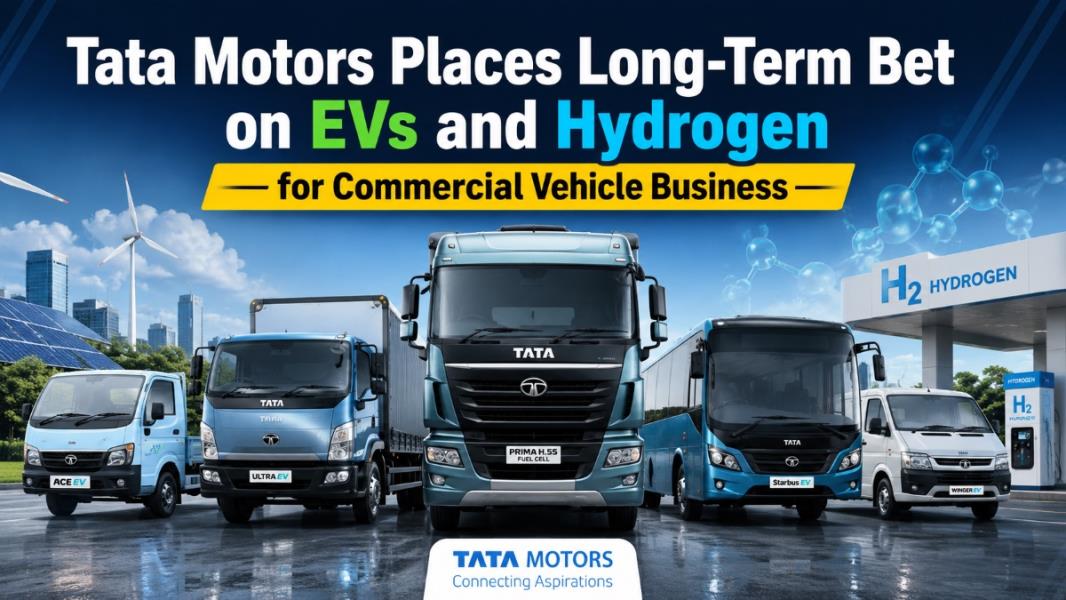
Table of Contents
| 1. One Market, Different Requirements |
| 2. Financial Performance Adds Confidence |
| 3. Future Is Not Just About Engines |
| 4. Looking Beyond Today's Market |
► Read More: Bosch Expands EV Technology Portfolio with New SiC Chip Generation
Ask a city-based delivery operator what matters most and the answer may be very different from someone running heavy cargo routes across states. That is one reason Tata Motors believes multiple technologies may be needed in the future. Battery-powered vehicles are attracting attention in urban operations, while hydrogen is increasingly being discussed for applications involving heavier loads and longer distances. For Tata Motors, choosing only one path right now may not make much sense.
Instead, the company wants to keep building expertise across different technologies and then respond according to market demand. It is a strategy that gives flexibility, especially at a time when the transport industry is still figuring out what the future will actually look like.
Financial Performance Adds Confidence
The timing of this announcement is not accidental. Tata Motors has just come out of a strong financial year. Revenue touched Rs. 83,855 crore in FY26, higher than the previous year's figure. The company's automotive business also reported a ROCE of 72.3%.
Numbers like these usually give companies more room to think long-term. Rather than focusing only on immediate returns, businesses with strong financial performance can continue investing in technologies that may take years to reach their full potential. That seems to be the position Tata Motors finds itself in today.
Future Is Not Just About Engines
When people hear terms like EVs or hydrogen vehicles, they often think only about the power source. But the company is looking at a much bigger picture. Artificial intelligence, connected vehicle systems, ADAS features and data-based fleet services are all part of the roadmap. In fact, many transport operators now expect software and connectivity features to be just as important as engine performance.
This trend is visible across different vehicle categories, from Tata mini trucks used for local transportation to larger Tata trucks operating in logistics fleets.
Looking Beyond Today's Market
Nobody really knows for sure what technology will be the thing in commercial transportation in ten years. That is exactly why Tata Motors is looking at a lot of things at the same time instead of putting all of its money and people into just one thing; Tata Motors is trying to cover all its bases with commercial transportation.
The company plans to continue work on Tata electric trucks, hydrogen-powered Tata commercial vehicles and cleaner engine technologies at the same time. From its perspective, the transition towards cleaner mobility has already begun, even if the pace differs from one segment to another.
► You Might Like: BYD Bets on DM-i Hybrid Technology for Indian Customers
Frequently Asked Questions on Commercial Vehicles
Q1. What is the starting price of Tata commercial vehicles in India?
Ans. Tata commercial vehicles start from around ₹4 lakh for small cargo carriers, while heavy-duty trucks can cost more than ₹50 lakh depending on the model and application.
Q2. Which Tata truck gives the best mileage for long-distance transport?
Ans. Mileage depends on load and route conditions, but several Tata heavy-duty trucks are known to deliver fuel efficiency between 3.5 kmpl and 6 kmpl in highway operations.
Q3. What is the seating capacity of Tata Winger passenger vehicles?
Ans. Depending on the variant, Tata Winger models are available with seating capacities ranging from 9 seats to more than 20 seats.
Q4. Is Tata Motors planning more electric commercial vehicles in the future?
Ans. Yes, Tata Motors continues to expand its electric commercial vehicle portfolio and is also investing in new technologies to support future transport requirements.
Join us for the latest updates on the Truck Industry -
☞ 
 Facebook
☞  Instagram
☞  YouTube
☞  Twitter
☞  LinkedIn
☞  Threads

About the Author

Jony Shekhawat
Jony Shekhawat is a skilled content writer at TrucksBuses.com, one of India’s top platforms for commercial vehicle news and reviews. With roots in social work and a keen interest in the logistics and mobility space, Jony crafts content that is both insightful and easy to understand. He specializes in breaking down complex commercial vehicle trends, helping readers make informed decisions. His writing not only informs but also aims to support the growth of India's transport community through knowledge and awareness.