KPMG Sees Strong Growth in India’s Electric Vehicle Market
By Jony Shekhawat | Published Date : December 16, 2025
KPMG report says electric vehicles will play a major role in India’s mobility shift over the next decade.
India’s electric vehicle sales are expected to reach nearly 22 million units by 2035. This estimate has been shared in a new report by KPMG Assurance and Consulting Services LLP. The report talks about the future of electric mobility in India with a strong focus on supply chain challenges.
At present, electric vehicle adoption is growing fast. EV sales reached around 1.5 million units in FY25.
Two-Wheelers vs 3-Wheelers on City Roads
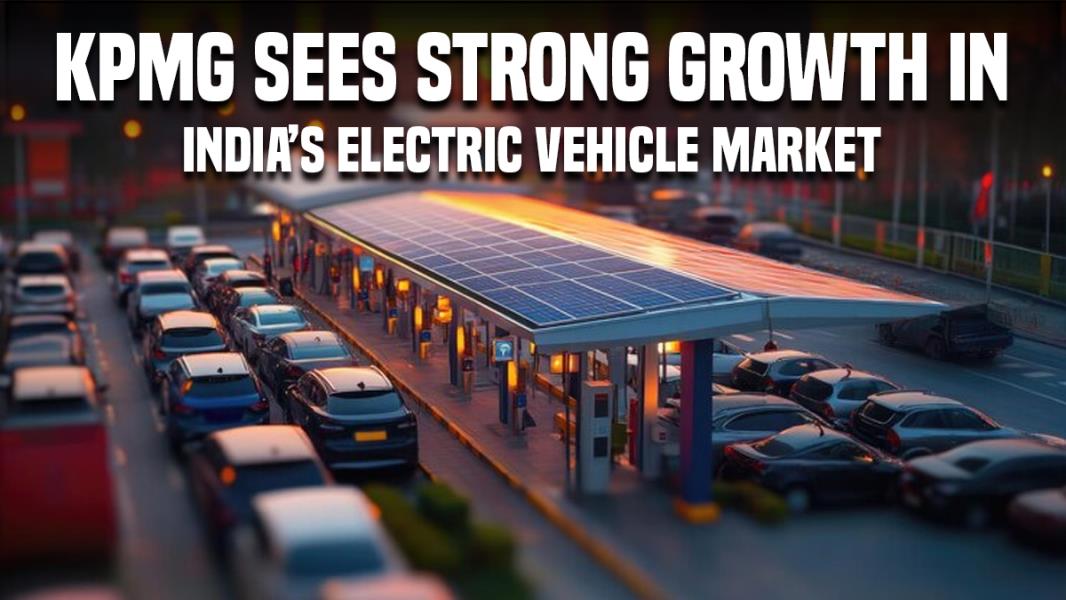
Table of Contents
| 1. Two-Wheelers vs 3-Wheelers on City Roads |
| 2. Cost Advantage Helping EV Growth |
| 3. Charging Network Sees Big Expansion |
| 4. Mineral Supply Remains a Major Challenge |
| 5. India’s Roadmap for EV Supply Security |
Read More: Ashok Leyland Shares Rise on CV Growth Outlook
The report shows that two-wheelers dominate the EV market. Nearly 80 to 85 per cent of total EV sales come from this segment. The main reasons are low cost, easy charging, simple use in cities. Three-wheelers also play an important role in electric mobility. Four-wheelers are also growing slowly. Premium electric cars with driving range above 500 kilometres are gaining attention. By mid-2025, such vehicles accounted for around 27 per cent of electric four-wheeler sales.
Cost Advantage Helping EV Growth
Electric vehicles already offer total cost advantage in many categories. Scooters, electric three-wheelers, city-based buses show lower running costs over time.
For four-wheelers, cost balance has already been achieved for commercial use. For personal buyers, cost balance is expected before the end of this decade. This is likely to push more customers towards electric options.
Charging Network Sees Big Expansion
In 2022, India had around 5,000 public charging stations. By early 2025, this number crossed 26,000. Government schemes have played a major role. Programs like FAME have supported EV growth for many years. The PM E-DRIVE scheme was launched in September 2024 with funding of Rs 10,900 crore. These steps helped improve confidence among buyers.
Mineral Supply Remains a Major Challenge
The report highlights serious supply risks related to battery minerals. Electric vehicles need much higher mineral input compared to conventional vehicles. Batteries are the main reason for this gap.
Lithium, cobalt and nickel supplies are controlled by a few countries. China holds major control over mineral refining plus rare earth processing. Recent export controls by China have raised concerns globally. Mineral prices have also shown high fluctuation.
India’s Roadmap for EV Supply Security
India has mineral resources but lacks large-scale processing capacity. Lithium resources were identified in Jammu and Kashmir but remain in early stages. Cobalt plus nickel resources also exist but need development.
The report suggests a clear strategy. Short-term steps include trade agreements with mineral-rich countries. Medium-term focus is on processing units plus recycling.
KPMG says electric vehicles remain the most practical solution for clean mobility in India. Future success depends on better batteries, safer motors and strong supply chains.
Also Read: Montra Electric Super Auto: A New Benchmark in Urban Electric Mobility
Frequently Asked Questions on Commercial Vehicles
Q1. What makes electric vehicles popular in cities?
Ans. Electric vehicles are quiet, cheaper to run, easy to charge overnight, and suitable for short daily travel inside cities.
Q2. Are three-wheelers suitable for electric technology?
Ans. Yes, electric three-wheelers work well due to lower running costs, simple design, and frequent city usage.
Q3. How important is charging infrastructure for EV growth?
Ans. Charging stations help reduce range worry, increase user confidence, and support wider EV adoption.
Q4. Do electric four-wheelers cost less in the long run?
Ans. Over time, electric four-wheelers save money due to lower fuel costs and fewer maintenance needs.
Join us for the latest updates on the Truck Industry -
☞  Facebook
☞  Instagram
☞  YouTube
☞  Twitter
☞  LinkedIn
☞  Threads

About the Author

Jony Shekhawat
Jony Shekhawat is a skilled content writer at TrucksBuses.com, one of India’s top platforms for commercial vehicle news and reviews. With roots in social work and a keen interest in the logistics and mobility space, Jony crafts content that is both insightful and easy to understand. He specializes in breaking down complex commercial vehicle trends, helping readers make informed decisions. His writing not only informs but also aims to support the growth of India's transport community through knowledge and awareness.