Government Holds Broad ZEV Definition Despite Pressure from Automakers
By Jony Shekhawat | Published Date : March 31, 2026
NITI Aayog keeps a wider definition of zero-emission vehicles, allowing multiple fuel technologies to grow instead of focusing only on electric options.
Niti Aayog has made a decision to stick with what they think a zero-emission vehicle is. Some big car companies asked Niti Aayog to be more strict about what makes a zero-emission vehicle. Niti Aayog said no to that request. Companies like Tata Motors, Mahindra and Mahindra, JSW and MG Motor want zero-emission vehicles to be the vehicles that do not put out anything bad from the tailpipe, which is what they think zero-emission vehicles should be. Niti Aayog is still going to call a vehicle a zero-emission vehicle even if it's not as strict as what these companies wanted for zero-emission vehicles. In simple terms, they were pushing for electric and hydrogen vehicles to be treated separately from other options.
Electric Vehicles With Other Mixed Fuels
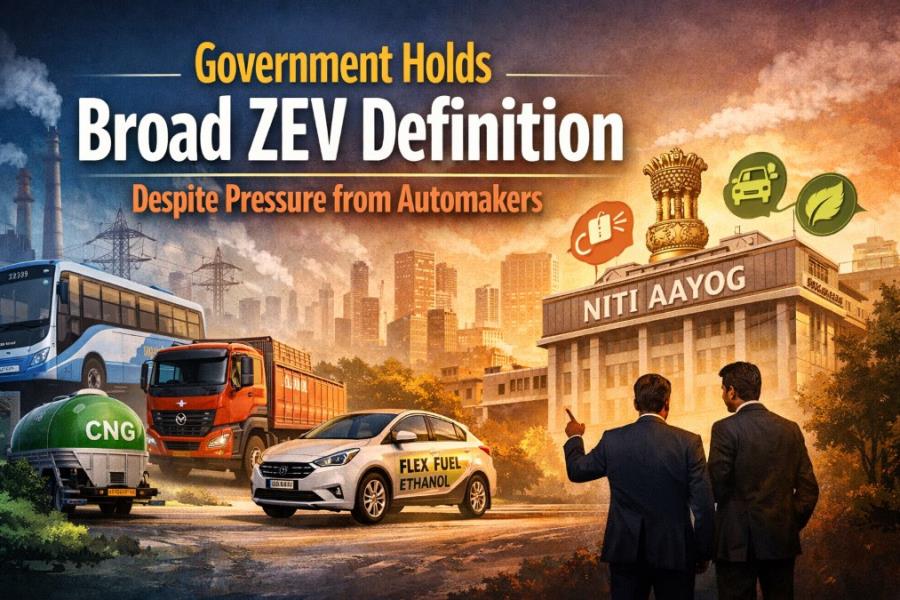
Table of Contents
| 1. Electric Vehicles With Other Mixed Fuels |
| 2. Why This Matters for the Industry |
| 3. Gradual Shift Without Quick Jump |
| 4. Support From Green Energy Group |
| 5. Future Expectations |
► Read More: IndianOil Limits XP-95 Supply Due to Rising Global Crude Prices
As things stand, the definition being followed is wider. It includes not just electric vehicles, but also flex-fuel models, hybrid vehicles and those running on compressed bio-gas.
Officials feel that looking only at tailpipe emissions does not give the full picture. Instead, they are considering emissions across the entire lifecycle — from fuel production to actual usage on road.
Why This Matters for the Industry
For companies, this changes how future planning may happen. A single direction towards only EVs is not being pushed right now. Instead, there is space for multiple technologies to grow together.
This could reflect across segments like Tata trucks and Mahindra trucks, where different fuel options are already being tested. The same applies to public transport vehicles such as Tata buses and Mahindra buses, where operators may continue exploring more than one solution.
Gradual Shift Without Quick Jump
The plan is not about an overnight shift. The idea is to move in stages. First, reduce diesel use and bring in cleaner options like CNG, hybrids and electric commercial vehicles.
fter that, increase the role of biofuels. And in the long run, scale up cleaner technologies across all vehicle types. So, instead of a direct jump, it’s more of a slow transition.
Support From Green Energy Group
Interestingly, the Indian Federation of Green Energy has supported this decision. The group has said that the government has done the right thing by not changing its position under pressure.
It also pointed out that emissions should not be judged only from what comes out of the vehicle, but from the entire process behind it.
Future Expectations
For smaller segments like Tata mini trucks, this approach may actually make things easier. Instead of being forced into one technology, manufacturers and buyers can look at different options depending on cost and usage.
At the end of the day, the goal remains the same — reducing emissions and moving towards cleaner mobility. The only difference is how that journey is being planned.
For now, the message is clear: India is not choosing one path, but keeping multiple routes open.
► You Might Like: Eicher Opens Pro X Small Truck Outlet in Faridabad
Frequently Asked Questions on Commercial Vehicles
Q1. What is the mileage of Tata commercial trucks?
Ans. Mileage depends on the model and load, but most Tata trucks offer around 5 to 9 km/l, with newer models focusing on better fuel efficiency.
Q2. Are Mahindra commercial vehicles good for rural use?
Ans. Yes, Mahindra pickups and small commercial vehicles are widely used in rural areas due to their durability, low maintenance, and strong load capacity.
Q3. What is the starting price of Tata mini trucks in India?
Ans. Tata mini trucks like Ace series usually start from around ₹4 lakh (ex-showroom), depending on variant and fuel type.
Q4. Do Mahindra commercial vehicles come in electric variants?
Ans. Yes, Mahindra offers electric options like the Treo range, mainly focused on last-mile delivery and urban transport needs.
Join us for the latest updates on the Truck Industry -
☞  Facebook
☞  Instagram
☞  YouTube
☞  Twitter
☞  LinkedIn
☞  Threads

About the Author

Jony Shekhawat
Jony Shekhawat is a skilled content writer at TrucksBuses.com, one of India’s top platforms for commercial vehicle news and reviews. With roots in social work and a keen interest in the logistics and mobility space, Jony crafts content that is both insightful and easy to understand. He specializes in breaking down complex commercial vehicle trends, helping readers make informed decisions. His writing not only informs but also aims to support the growth of India's transport community through knowledge and awareness.