Viral Bluetooth App Raises Cybersecurity Concerns for Electric Rickshaws
By Jony Shekhawat | Published Date : July 02, 2026
Viral videos showing a Bluetooth app reportedly switching off some electric rickshaws have raised fresh questions about battery security and cybersecurity as connected electric three-wheelers become more common across India.
July 2, 2026 | 3 min read | Electric Three Wheelers
Recent videos shared on social media have started a new discussion about the safety of connected electric vehicles. The clips appear to show a Bluetooth mobile app turning off the power of some electric rickshaws while they are moving on the road. The videos have not been independently verified, but they have raised concerns about cybersecurity in India's growing electric mobility market.
Viral Videos Draw Attention to Battery Security
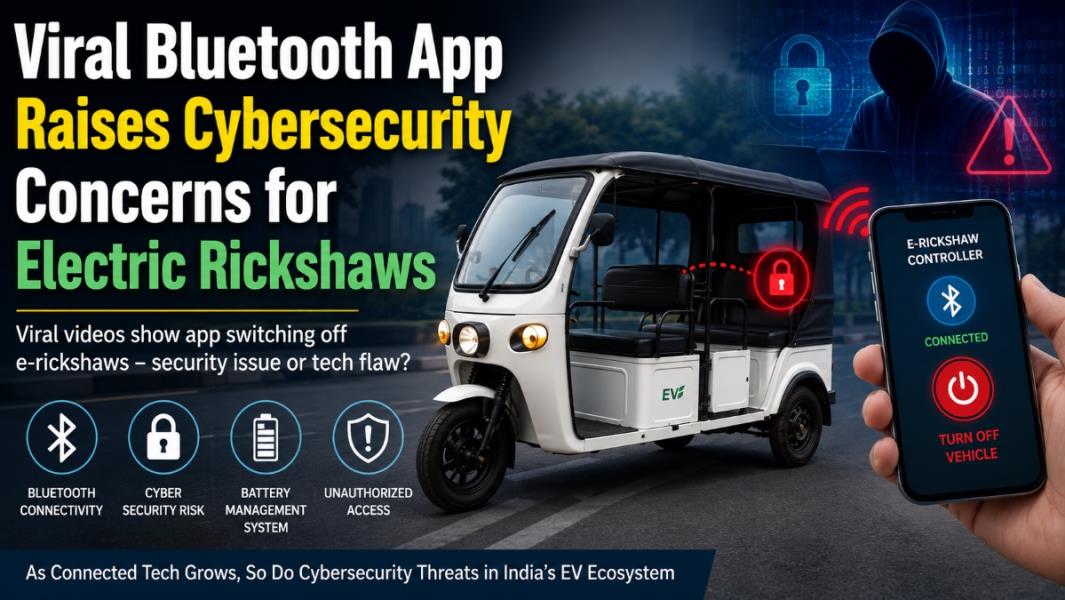
Table of Contents
| 1. Viral Videos Draw Attention to Battery Security |
| 2. How the Battery Management System Works |
| 3. Not Every Electric Vehicle Is Affected |
| 4. Better Cybersecurity Is Becoming More Important |
► Read More: Tata Motors Tackles Global Risks with Smart Business Strategy
The videos show an electric 3-wheeler stopping after someone uses a smartphone application. This has made many people wonder whether some battery systems can be controlled through Bluetooth without proper security. The name of the app has not been shared by several media platforms to prevent possible misuse.
How the Battery Management System Works
Most lithium-ion battery packs have a Battery Management System, which is also called a BMS. The Battery Management System checks the battery temperature and the charging status and the overall health of the lithium-ion battery. The Battery Management System can also connect to a smartphone using Bluetooth in some cases.
This is helpful for people who own lithium-ion battery packs and for service technicians because they can easily check the details of the lithium-ion battery. However, if the Bluetooth protection is not strong someone who is not supposed to and who is standing close by might try to connect to the lithium-ion battery.
Depending on how the battery has been designed, such access could temporarily stop the battery output. Still, experts believe this does not mean every battery pack is exposed to the same risk.
Not Every Electric Vehicle Is Affected
Battery makers use different software, hardware and security methods. Some battery packs do not support Bluetooth at all. Others require passwords or additional verification before anyone can change settings.
This means the viral videos should not be taken as proof that every electric vehicle has the same weakness. Popular manufacturers offering Bajaj 3 wheelers, Piaggio 3 wheelers and other commercial electric vehicles may use different security systems depending on the model and battery supplier.
Better Cybersecurity Is Becoming More Important
As more cars get connected through tech security is getting really important, just like safety. Car makers need to make Bluetooth logins more secure use codes for messages and give software updates whenever they find new security problems. They have to do this to keep our cars safe from hackers. New security issues are found all the time so they must keep updating their software. This way we can trust that our connected cars are safe to drive.
Modern passenger electric cars already use multiple security layers, making them much harder to access without permission. Similar protection is likely to become more common in commercial vehicles as well. With the growing demand for electric mobility, including models like the Mahindra Udo EV, strong digital protection will become an important part of future vehicle design. The recent videos are a reminder that connected technology must always be supported by proper cybersecurity to keep both vehicles and users safe.
► You Might Like: Tata Motors Leads Commercial Vehicle Market in May 2026
Frequently Asked Questions on Commercial Vehicles
Q1. What is the price of an electric 3-wheeler in India?
Ans. The price of an electric 3-wheeler generally starts from around ₹3 lakh (ex-showroom) and can go above ₹5.5 lakh, depending on the battery type, seating or cargo configuration and brand.
Q2. What is the average range of an electric 3-wheeler on a full charge?
Ans. Most electric 3-wheelers offer a driving range of around 80 km to 180 km on a full charge. The actual range depends on battery capacity, load, road conditions and driving style.
Q3. What is the seating and loading capacity of electric 3-wheelers?
Ans. Passenger electric 3-wheelers usually have a driver plus 3 to 4 passenger seating capacity. Cargo models generally offer a payload capacity between 300 kg and 700 kg, depending on the vehicle.
Q4. How long does it take to charge an electric 3-wheeler battery?
Ans. Most electric 3-wheelers take 3 to 6 hours for a full charge. Charging time varies based on the battery size, charger type and the technology used by the manufacturer.
Join us for the latest updates on the Truck Industry -
☞ 
 Facebook
☞  Instagram
☞  YouTube
☞  Twitter
☞  LinkedIn
☞  Threads

About the Author

Jony Shekhawat
Jony Shekhawat is a skilled content writer at TrucksBuses.com, one of India’s top platforms for commercial vehicle news and reviews. With roots in social work and a keen interest in the logistics and mobility space, Jony crafts content that is both insightful and easy to understand. He specializes in breaking down complex commercial vehicle trends, helping readers make informed decisions. His writing not only informs but also aims to support the growth of India's transport community through knowledge and awareness.