SUN Mobility Gets AIS-038 Certification for Swappable EV Battery Platform
By Jony Shekhawat | Published Date : March 30, 2026
India’s first AIS-038 certified swappable battery platform aims to support large-scale adoption of EVs in the commercial vehicle segment.
SUN Mobility has received a major certification for its battery swapping system designed for heavy vehicles. The Bengaluru-based company said its high-voltage swappable battery platform has been approved under AIS-038 standards by the Automotive Research Association of India (ARAI), Chakan.
This is being seen as a first in India, especially for a system developed locally for large commercial use. The platform has been tested for safety, performance and reliability before getting the certification.
Years Of Development
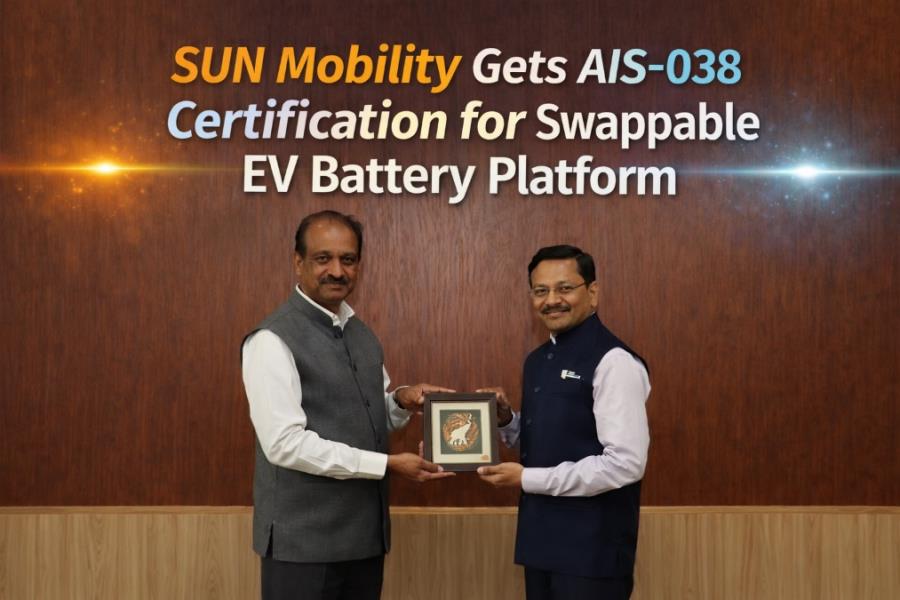
Table of Contents
| 1. Years Of Development |
| 2. Flexible Design For Different Vehicle Types |
| 3. Timing Aligns With Government Push |
| 4. Company’s Current Reach |
| 5. Step Forward With Challenges Ahead |
► Read More: IndianOil Limits XP-95 Supply Due to Rising Global Crude Prices
The company has been working on swapping solutions for a few years now. It first introduced a similar concept for buses back in 2019. Since then, it has continued to develop the technology.
According to the company, this latest platform is the result of long-term research and in-house development. It has also filed over 160 patents, with several already approved. The focus has been to make systems that can support different types of commercial electric vehicles without major changes.
Flexible Design For Different Vehicle Types
The certified battery system comes in two main variants — 50 kWh and 100 kWh. Both operate in a high-voltage range and can also be combined depending on the requirement.
One important thing about this system is that it has a design. This means it does not have to come from one company and it can be used in different kinds of vehicles. This makes the system a good choice for different uses, including electric trucks and other big vehicles that need to carry heavy loads.
The company says that this ability to adapt is helpful, to people who manage fleets of vehicles because it lets them choose how battery power they need for their specific situation. It also reduces downtime since batteries can be swapped quickly instead of waiting for charging. This is where battery swapping technology is seen as an advantage in daily operations.
Timing Aligns With Government Push
The certification comes at a time when the government is pushing electric mobility more actively. Schemes are already in place to support adoption, especially for larger vehicles like electric buses.
For companies looking to shift to EVs, having a certified and tested system makes decision-making easier. It also supports the growth of EV charging infrastructure, though swapping offers a slightly different approach.
Company’s Current Reach
SUN Mobility, founded in 2017, says it has already set up over 1,300 swap stations across more than 20 cities. The company claims millions of battery swaps have been completed so far, helping vehicles cover a large number of electric kilometres.
Its network supports multiple vehicle categories, including smaller formats like electric mini trucks, which are becoming common in last-mile delivery. The company also operates a joint venture with Indian Oil, aimed at expanding swapping points further across the country.
Step Forward With Challenges Ahead
Getting certified is a step but the real test is getting people to use battery swapping everywhere. This will not happen until companies that make vehicles and people who run services get on board.
This approval is a help for SUN Mobility, it will make it easier for them to become a bigger player in Indias electric vehicle market. Now they can focus on making their technology available throughout the country. SUN Mobility is, in a place to make this happen.
► You Might Like: Eicher Opens Pro X Small Truck Outlet in Faridabad
Frequently Asked Questions on Commercial Vehicles
Q1. What are commercial vehicles?
Ans. Commercial vehicles are used for transporting goods or passengers, such as trucks, buses, vans, and pickups.
Q2. What is the difference between light and heavy commercial vehicles?
Ans. Light commercial vehicles are smaller and used for short-distance transport, while heavy commercial vehicles handle large loads and long-distance operations.
Q3. Are electric commercial vehicles suitable for long routes?
Ans. Yes, many modern electric commercial vehicles are designed for longer routes, though range depends on battery capacity and load conditions.
Q4. What factors affect the performance of commercial vehicles?
Ans. Load weight, driving conditions, maintenance, fuel or battery type, and driver behaviour all play an important role in performance.
Join us for the latest updates on the Truck Industry -
☞  Facebook
☞  Instagram
☞  YouTube
☞  Twitter
☞  LinkedIn
☞  Threads

About the Author

Jony Shekhawat
Jony Shekhawat is a skilled content writer at TrucksBuses.com, one of India’s top platforms for commercial vehicle news and reviews. With roots in social work and a keen interest in the logistics and mobility space, Jony crafts content that is both insightful and easy to understand. He specializes in breaking down complex commercial vehicle trends, helping readers make informed decisions. His writing not only informs but also aims to support the growth of India's transport community through knowledge and awareness.