Olectra CEO Predicts 50% Electric Bus Adoption and 35% Electric Truck Penetration by 2035
By Amit Jangra | Published Date : June 06, 2026
Olectra CEO expects 50% electric bus adoption and 35% electric truck penetration by 2035, driven mainly by cost economics and operational savings.
India’s commercial vehicle market is expected to see a big shift over the next decade, especially in the electric buses segment. According to Olectra Greentech Chief Executive Officer Mahesh Babu, nearly half of all new bus sales in the country could be electric by 2035. He also said electric trucks could reach around 35% share in the coming years. This shows that the transport sector is slowly moving towards cleaner options, especially in heavy vehicles. Babu said that commercial transport will likely move quicker because these vehicles run more frequently and offer better savings in long-term operating costs.
Economics Driving EV Adoption, Not Just Environment
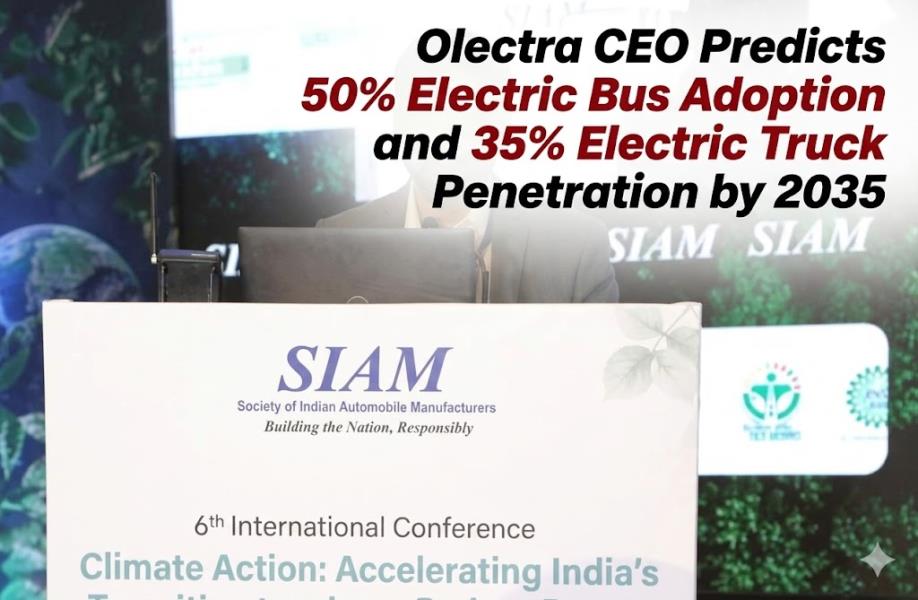
Table of Contents
| 1. Economics Driving EV Adoption, Not Just Environment |
| 2. Commercial Vehicles Show Faster Transition |
| 3. Policy Support Helping Electric Bus Growth |
| 4. Electric Truck Adoption Still Slow |
| 5. Challenges in Transitioning to Clean Transport |
| 6. Long-Term Outlook Looks Positive |
► Read More: JK Tyre Reports Strong Q4 Profit Growth, Announces Major ₹4,980 Crore Expansion Investment
The CEO clearly highlighted that adoption is not only about pollution control. According to him, financial logic will decide how fast electric mobility grows in India. He explained that unless the cost per unit makes sense for customers, adoption will remain slow. “Unless you make unit economics work, nobody is going to adopt it,” he said while speaking about market reality. This thinking is already visible in other segments too. For example, Olectra buses are being considered by operators mainly because of lower running costs compared to diesel alternatives.
Commercial Vehicles Show Faster Transition
He also said electric trucks may reach around 35% share in the same period. This shows the transport sector is slowly shifting towards electric vehicles, especially in bigger and heavy-duty segments. The three-wheeler market already shows what is possible. Penetration in that category has reached nearly 50%, mainly because users see direct financial benefit. In a similar way, demand for Olectra trucks and other electric freight options may go up once costs come down and charging support gets better.
Policy Support Helping Electric Bus Growth
Government schemes like PM E-Drive and PM eBus Sewa are slowly helping electric buses grow in India. These programmes are mainly supporting public transport systems and city operators to switch towards cleaner options. In FY2026, electric buses made up around 4.5% of total bus sales. Most of this demand is coming from government and public sector transport orders rather than private buyers.
A big development came in December 2025 when a large order of 10,900 buses was awarded. This is expected to push more cities to introduce electric fleets. It also gives manufacturers confidence to increase production capacity.
Electric Truck Adoption Still Slow
The government has also introduced support under PM E-Drive for electric trucks, but the response in freight transport is still slow. The main reason is simple — upfront cost is still high, and many fleet owners are not fully ready to switch. Some operators are also waiting because incentives are limited and not very strong compared to the investment needed. Rules around scrappage and overall uncertainty in daily operations are also causing transport companies to think twice before taking big decisions.
Challenges in Transitioning to Clean Transport
Even after policy support, switching from diesel to electric is still a slow process in heavy transport. Most operators still rely on diesel trucks and buses since they already have the setup and experience. Charging network limitations and high vehicle cost are still major concerns. That’s why adoption is happening slowly, especially in long-distance freight movement.
Long-Term Outlook Looks Positive
Experts believe that over time, things will improve. As battery prices come down and technology becomes better, both electric buses and electric trucks will become more practical for daily use.
Mahesh Babu also mentioned that success of any technology will depend on economics. Whether it is EV, hydrogen or flex fuel, companies will only adopt it when it actually saves money in real operations. So the future of transport in India is likely to be a mix of gradual transition, where cleaner vehicles slowly replace traditional ones. By 2035, electric mobility could become a much bigger part of India’s transport system, especially in public transport and freight movement.
► You Might Like: Bajaj Auto Leads 3-Wheeler Auto-Rickshaw Sales in Q4 FY26, Mahindra Follows
Frequently Asked Questions on Commercial Vehicle
1. What is the Olectra CEO’s forecast for electric buses by 2035?
Ans: He expects electric buses to reach around 50% of new bus sales in India by 2035.
2. What is the expected penetration of electric trucks?
Ans: Electric trucks are expected to reach nearly 35% market penetration by 2035.
3. What is the main reason for EV adoption according to the CEO?
Ans: The main reason is economics and cost savings, not just environmental concerns.
4. Which factors are slowing electric truck adoption?
Ans: High upfront cost, limited incentives, scrappage rules, and infrastructure gaps are slowing adoption.
Join us for the latest updates on the Truck Industry -
☞ 
 Facebook
☞  Instagram
☞  YouTube
☞  Twitter
☞  LinkedIn
☞  Threads

About the Author

Amit Jangra
Amit Jangra is a dedicated content writer at TrucksBuses.com, a leading Indian portal for commercial vehicle insights. With a strong background in social work and a passion for the transportation sector, Amit brings a unique perspective to his writing. His articles are known for their clarity and depth, making complex topics accessible to a broad audience. Amit's commitment to empowering readers through informative content reflects his broader mission of societal upliftment.