NITI Aayog Puts Energy Security at the Centre of India's EV Push
By Jony Shekhawat | Published Date : June 18, 2026
NITI Aayog says India's EV transition is helping improve energy security, strengthen local manufacturing and support the adoption of electric commercial vehicles across multiple transport segments.
Jun 18, 2026 | 4 min read | EV Policy
India's transition to electric mobility is moving ahead at a steady pace, but the conversation is now going beyond emissions and cleaner transport. At the Transportation Decarbonization Summit (TDS) 2026 in Berlin, Archana Mittal of NITI Aayog said electric vehicles can also help India strengthen its energy security and reduce reliance on imported fuel.
According to her, the country's EV plans are being shaped by both environmental and economic priorities. This includes support for a wide range of vehicle categories such as electric buses, electric trucks and electric 3-wheelers, which are gradually becoming part of India's transport network.
EV Policies Continue to Expand
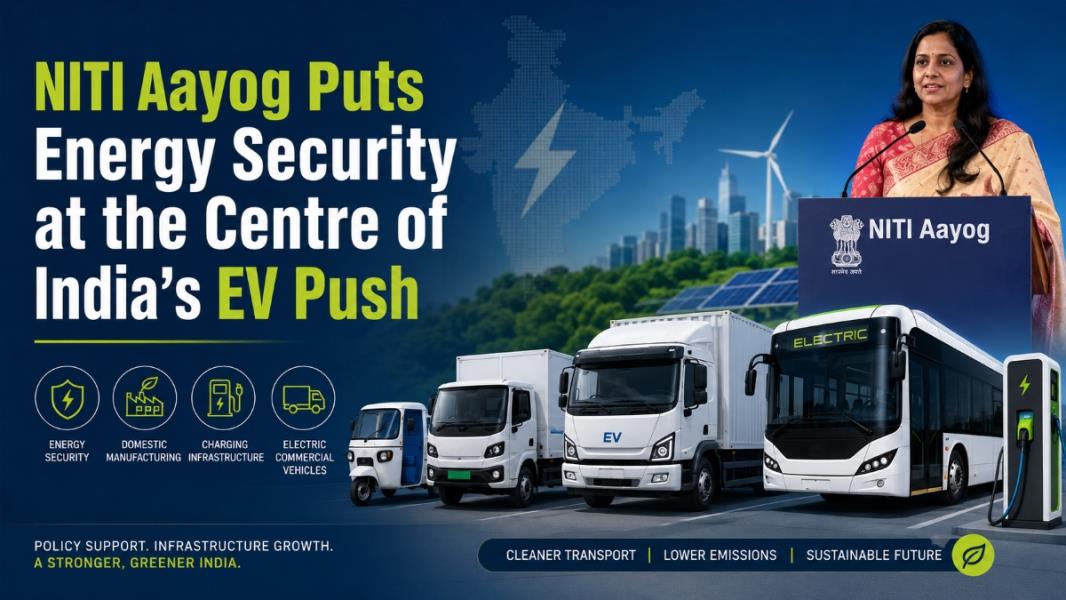
Table of Contents
| 1. EV Policies Continue to Expand |
| 2. Manufacturing Remains a Key Focus |
| 3. Charging Network Gets More Attention |
| 4. Why This Matters |
| 5. Final Take |
► Read More: E25 Gains Attention as India Looks Beyond E20 Ethanol Blending
India is really trying to get electric vehicles on the road. The government has started a lot of programs to help this happen. One of the big programs was the FAME scheme, which started in 2015. Since the FAME scheme began, the government has introduced programs to help more people buy electric vehicles and to improve the roads and other things that electric vehicles need.
Mittal talked about programs like the PM E-DRIVE and the PM eBus Sewa. These programs are helping to get electric vehicles on the roads in India. The electric vehicles are becoming more common in India because of these programs. These programmes are not limited to passenger vehicles and also support segments that are important for public transport and commercial operations.
As adoption grows, electric buses are becoming more common in city transport systems, while trucks are beginning to attract attention from logistics operators looking for cleaner alternatives.
Manufacturing Remains a Key Focus
The government is working on the manufacturing side of the Electric Vehicle ecosystem. Mittal said that the Production Linked Incentive schemes are helping to increase the production of batteries and automotive components.
Building a domestic supply chain for Electric Vehicles can reduce our dependence on imports and create opportunities for investment and employment in the Electric Vehicle sector. India is also looking at ways to strengthen access to battery materials and critical minerals that will be needed as the demand, for Electric Vehicles continues to grow.
For manufacturers of electric commercial vehicles, including electric buses, these efforts could help support future production and expansion plans.
Charging Network Gets More Attention
Charging infrastructure remains one of the areas receiving significant attention from policymakers. A wider charging network is considered essential if EV adoption is to increase across different parts of the country. Mittal highlighted the recent approval of ₹127 crore for public charging infrastructure in Delhi. The plan is expected to expand the city's charging network to nearly 32,000 charging points by 2028.
Improved charging availability will support a growing number of electric vehicles on the road, including electric 3-wheelers used for last-mile transport, electric mini trucks used in urban deliveries and electric buses operating in public transport fleets.
Why This Matters
The government's latest comments show that electric mobility is increasingly being linked with energy security. Reducing dependence on imported fuel remains an important objective as India works towards its long-term transport goals.
At the same time, stronger manufacturing capabilities and better charging infrastructure could help create favourable conditions for the wider adoption of electric commercial vehicles, including mini trucks, buses and other cargo transport solutions.
Final Take
The message from NITI Aayog at the Berlin summit was clear. India's EV transition is not only about cleaner transportation but also about building a more secure and self-reliant transport ecosystem. With continued policy support, infrastructure investment and manufacturing growth, electric commercial vehicles are expected to play a larger role in the country's mobility future.
► You Might Like: Up to 8% Discount on New Vehicles Under Ashok Leyland and Switch Mobility Replacement Scheme
Frequently Asked Questions on Commercial Vehicles
Q1. What is the price of an electric commercial vehicle in India?
Ans. The price of electric commercial vehicles varies by segment. Electric 3-wheelers generally start from around ₹3 lakh, while electric mini trucks can cost between ₹6 lakh and ₹12 lakh. Electric buses and electric trucks are priced significantly higher depending on battery size and payload capacity.
Q2. How much time does an electric commercial vehicle take to charge?
Ans. Charging time depends on battery size and charger type. Most electric 3-wheelers and electric mini trucks can be charged in 3 to 8 hours using standard charging systems. Fast charging can reduce charging time considerably for some models.
Q3. What is the loading capacity of electric mini trucks?
Ans. Electric mini trucks available in India typically offer payload capacities ranging from around 500 kg to more than 1,700 kg. The actual capacity depends on the vehicle model, battery configuration and intended application.
Q4. How much range can an electric commercial vehicle deliver on a single charge?
Ans. The driving range varies by vehicle category. Electric 3-wheelers generally offer 80-200 km, electric mini trucks can provide 120-300 km, while some electric trucks and buses are capable of covering even longer distances depending on battery capacity and operating conditions.
Join us for the latest updates on the Truck Industry -
☞ 
 Facebook
☞  Instagram
☞  YouTube
☞  Twitter
☞  LinkedIn
☞  Threads

About the Author

Jony Shekhawat
Jony Shekhawat is a skilled content writer at TrucksBuses.com, one of India’s top platforms for commercial vehicle news and reviews. With roots in social work and a keen interest in the logistics and mobility space, Jony crafts content that is both insightful and easy to understand. He specializes in breaking down complex commercial vehicle trends, helping readers make informed decisions. His writing not only informs but also aims to support the growth of India's transport community through knowledge and awareness.