India's three-wheeler market grew in FY26 as Bajaj Auto remained the leader. Mahindra and TVS expanded their market share through electric three-wheelers, signalling stronger competition in the segment.
Key points
- Bajaj Holds the Top Spot, But the Cushion is Thinning
- Mahindra's Electric Push is the Standout Story
- TVS Motor Nearly Doubles its Share
- Piaggio Steady, Smaller EV Specialists Lose Ground
- The Road Ahead for Bajaj
India's three-wheeler industry ended the year twenty twenty six with a total of thirteen lakh sixty-three thousand four hundred twelve units. This is more than the twelve lakh twenty thousand eight hundred 34 units sold in the year 2025. That is a jump of over eleven percent. If we look at the details, we see that the market leader, Bajaj Auto Ltd is losing its top spot. Even though Bajaj Auto Ltd sold 3-wheelers, its competitors are catching up. These competitors have electric three-wheeler options and they are slowly closing the gap, with Bajaj Auto Ltd and the three-wheeler industry. The three-wheeler industry is. The three-wheeler industry is getting more competitive.
Bajaj Holds the Top Spot, But the Cushion is Thinning
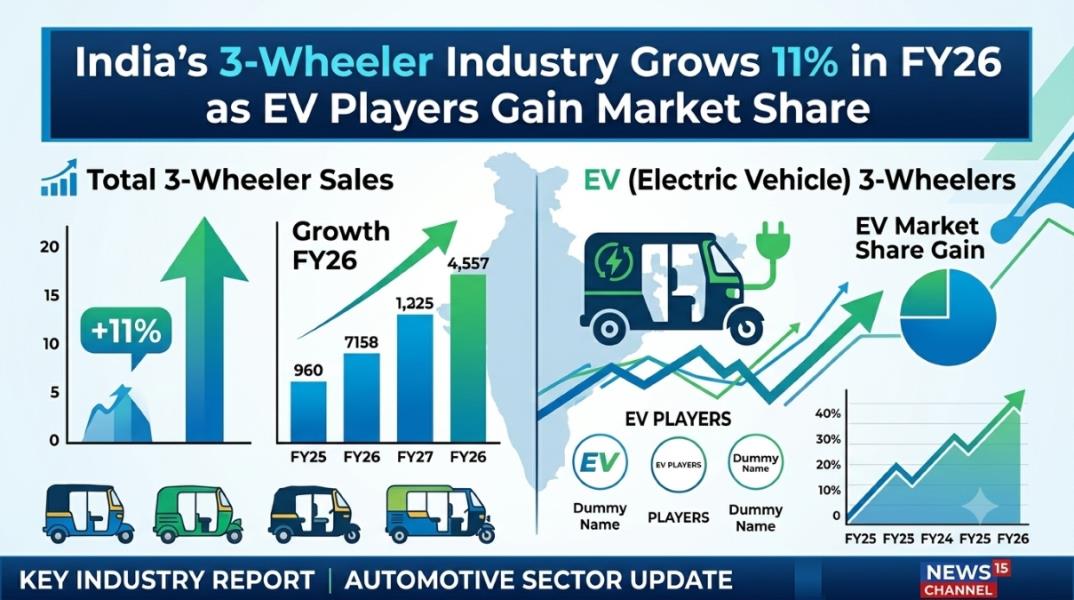
Table of Contents
| 1. Bajaj Holds the Top Spot, But the Cushion is Thinning |
| 2. Mahindra's Electric Push is the Standout Story |
| 3. TVS Motor Nearly Doubles its Share |
| 4. Piaggio Steady, Smaller EV Specialists Lose Ground |
| 5. The Road Ahead for Bajaj |
► Read More: Tata Motors Tackles Global Risks with Smart Business Strategy
Bajaj Auto ended FY26 with 4,73,247 units, comfortably ahead of the field and up from 4,37,678 units in FY25. In absolute terms, this represents healthy growth of over 8 per cent. However, its market share for the full year slipped to 34.71 per cent, down from 35.85 per cent in FY25 — a decline of over a full percentage point in a segment that itself grew by double digits.
A month-by-month reading of the first six months of 2026 shows the erosion becoming more pronounced as the year progressed. Bajaj's share stood at 35.38 per cent in January 2026, rose to a high of 38.04 per cent in February, and then began a steady slide — 37.50 per cent in March, 36.97 percent in April, 35.06 percent in May, and finally 33.82 percent in June. The June 2026 figure is particularly telling: at 33.82 per cent, it is markedly lower than the 37.54 percent share Bajaj held in June 2025, even though the company's unit volumes for the month actually grew year-on-year, from 39,058 to 40,883 units. The message is clear — the overall pie is growing faster than Bajaj's slice of it.
Mahindra's Electric Push is the Standout Story
The clearest beneficiary of this shift has been Mahindra & Mahindra Limited, whose three-wheeler business is increasingly driven by its dedicated electric arm, Mahindra Last Mile Mobility Ltd. The group's combined market share has climbed almost every month this fiscal year: from 6.47 per cent in January 2026 to 7.37 per cent in February, 9.08 percent in March, 10.15 per cent in April, 10.57 percent in May, and 11.12 percent in June. For the full year, Mahindra's share rose to 8.07 per cent from 6.37 per cent in FY25, with Mahindra Last Mile Mobility alone accounting for the vast majority of that volume — 1,09,135 of the group's 1,10,036 units in FY26. The conventional Mahindra & Mahindra entity, by contrast, contributed a negligible 901 units, underlining how central the electric last-mile business has become to the group's three-wheeler ambitions.
TVS Motor Nearly Doubles its Share
TVS Motor Company has posted an equally emphatic gain. Its FY26 market share rose to 4.07 per cent from just 2.12 per cent in FY25 — close to doubling — with monthly figures showing a consistent climb from 4.34 per cent in January to 5.30 per cent by June. TVS's three-wheeler play has leaned heavily on electric models, and the trend suggests the segment is rewarding OEMs that have moved decisively on electrification.
Piaggio Steady, Smaller EV Specialists Lose Ground
Piaggio Vehicles, historically the number two player, has seen its position stay largely range-bound but trend slightly downward — from 7.32 per cent in FY25 to 6.67 per cent in FY26 — even as Bajaj and the electrified challengers reshuffle the rest of the field. Interestingly, some of the smaller pure-play electric three-wheeler manufacturers have not benefited uniformly from the segment's electrification. YC Electric Vehicle's share fell from 3.66 per cent in FY25 to 2.70 per cent in FY26, while Saera Electric Auto and Dilli Electric Auto also saw their shares soften over the same period. This suggests that growth in the electric three-wheeler category is consolidating around larger, well-capitalised OEMs — Mahindra and TVS in particular — rather than being spread evenly across the specialist EV manufacturers that once dominated the space.
The Road Ahead for Bajaj
Bajaj Auto's three-wheeler business remains anchored largely in internal combustion and CNG platforms. With Mahindra and TVS both posting sustained month-on-month share gains through FY26 — and doing so specifically through electric models — the competitive pressure on Bajaj's leadership position looks set to intensify. Bajaj's absolute volumes continue to grow, and it remains the largest player by a wide margin, but the narrowing share gap through the course of FY26, especially the sharper drop seen between May and June, indicates that electrification is fast becoming the primary battleground in India's three-wheeler market — one where Bajaj will need to sharpen its response to defend its lead.
► You Might Like: Difference Between HSRP and Normal Number Plate for Commercial Vehicles
Frequently Asked Questions on Commercial Vehicles
Q1. What is the average price of a three-wheeler in India?
Ans. The price of a three-wheeler in India generally starts from around ₹2 lakh and can go beyond ₹5 lakh, depending on whether it is a passenger, cargo, CNG, diesel or electric model.
Q2. What is the loading capacity of a cargo three-wheeler?
Ans. Most cargo three-wheelers offer a payload capacity between 500 kg and 750 kg. However, some premium models can carry close to 1 tonne, depending on the manufacturer and variant.
Q3. Which three-wheeler gives the best mileage in India?
Ans. CNG three-wheelers are usually known for offering the best running economy, while electric three-wheelers provide the lowest cost per kilometre. The actual mileage or range depends on the vehicle, driving conditions and load.
Q4. Is it better to buy a CNG or electric three-wheeler?
Ans. It depends on your daily usage. A CNG three-wheeler is suitable for areas with easy CNG availability and long-distance operations. An electric three-wheeler is often a better option for city use because of its lower running and maintenance costs.
Join us for the latest updates on the Truck Industry -
☞ 
 Facebook
☞  Instagram
☞  YouTube
☞  Twitter
☞  LinkedIn
☞  Threads
