A clear breakdown of overloading challan and fine rules for commercial vehicles in India, including how penalties are calculated and how to avoid getting caught out.
Key points
- What Counts As Overloading Under Indian Law
- How The Fine Amount Is Actually Calculated
- Where And How Vehicles Get Caught
- Repeat Offences And What Happens Next
- How To Stay On The Right Side Of The Rules
Every transporter knows the temptation — one more sack of cement, one more crate, squeeze it in and save a second trip. It's a habit that's gotten a lot more expensive to keep in recent years, and it's not just the fine that hurts. An overloaded truck wears its tyres faster, strains its suspension, and is genuinely harder to stop in an emergency. This piece covers how overloading fines actually work in India, what triggers a challan, and what to check before your vehicle ends up on the wrong side of a weighbridge.
What Counts As Overloading Under Indian Law
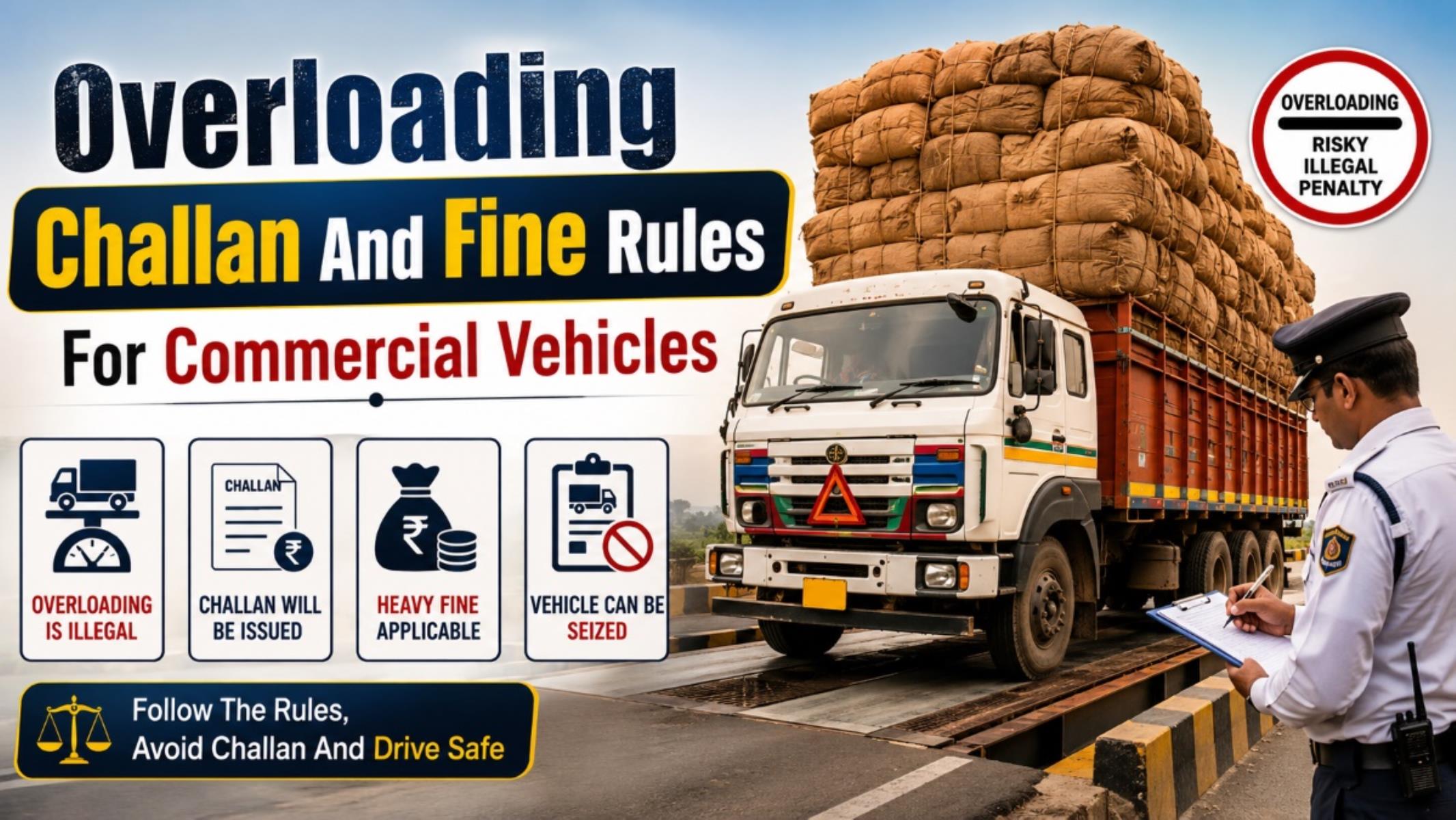
Table of Contents
|
1. What Counts As Overloading Under Indian Law |
|
2. How The Fine Amount Is Actually Calculated |
|
3. Where And How Vehicles Get Caught |
|
4. Repeat Offences And What Happens Next |
|
5. How To Stay On The Right Side Of The Rules |
Every commercial vehicle has a Gross Vehicle Weight (GVW) rating fixed by the manufacturer and recorded on its registration certificate — this is the absolute limit, not a suggestion. Cross it, even by a margin that feels small on paper, and the vehicle is legally overloaded. The Motor Vehicles Act treats this as a serious offence precisely because the risk isn't abstract — road damage, tyre blowouts and reduced braking ability all get worse in direct proportion to how far over the limit a truck is running.
How The Fine Amount Is Actually Calculated
Under the amended Motor Vehicles Act, overloading penalties are no longer a flat number — they scale with how much extra weight the vehicle is carrying. The base fine starts in the range of Rs 20,000, with an additional per-tonne charge added for every tonne over the limit. That structure means a truck carrying a modest excess pays noticeably less than one hauling several tonnes over its rating, but both are genuinely painful compared to what fines used to look like a few years back. States can also apply their own variations on top of the central framework, so the exact number isn't always identical from one state to the next.
Where And How Vehicles Get Caught
Weighbridges at state borders and highway checkpoints remain the most common enforcement point, but enforcement has gotten noticeably more digital in recent years — RTO teams increasingly cross-reference registration data electronically rather than relying purely on a manual weight check. If a challan does get issued, it usually shows up against the vehicle's registration number fairly quickly, so most operators tend to check regularly rather than waiting for paperwork to arrive by post.
► Read More: 5 Best Eicher Trucks In India: Explore Their Efficiency And Power
Repeat Offences And What Happens Next
A one-off overloading fine is annoying but survivable for most operators. Repeat violations are a different story — beyond the escalating fines, registration authorities can suspend a vehicle's fitness certificate or, in more serious repeat cases, take action against the permit itself. For a business running trucks, that kind of disruption to even one vehicle's paperwork can knock out a meaningful chunk of daily capacity, which usually costs far more than the fine itself would have. It's the same story on the passenger side — buses found overloaded with passengers beyond rated capacity face similar escalating consequences, since the safety risk there is arguably even more direct.
How To Stay On The Right Side Of The Rules
The simplest fix is also the most boring one: know your vehicle's actual GVW rating and don't guess at load weight — get it checked at a weighbridge when you're unsure, especially with irregular or bulky cargo that's hard to eyeball. This matters just as much for smaller operators running pickups and mini trucks on local routes, since their rated limits are lower and easier to cross without realising it. Staying within the rated limit is a habit worth building early, not something to figure out after the first fine.
"Now you can check and pay all kind of vehicle challans at TrucksBuses. To check vehicle challan, enter your vehicle number and we show you the entire list of pending online and court challans. What's more, you may even pay the same right there and we will dispose off the challans on your behalf."
Frequently Asked Questions on Commercial Vehicles
Q1. How is the overloading fine amount calculated?
Ans. The fine typically starts around Rs 20,000 as a base amount, with an additional per-tonne charge added for every tonne the vehicle exceeds its rated Gross Vehicle Weight, and can vary slightly by state.
Q2. Where are commercial vehicles typically checked for overloading?
Ans. Weighbridges at state borders and highway checkpoints are the most common enforcement points, though digital cross-checking of registration data is increasingly common too.
Q3. What happens if a vehicle is caught overloading repeatedly?
Ans. Beyond escalating fines, repeat violations can lead to suspension of the vehicle's fitness certificate or, in serious cases, action against its permit.
Q4. How can I check if my vehicle has an outstanding overloading challan?
Ans. You can look up a vehicle's challan and payment status using an online traffic challan lookup tool by entering the vehicle's registration number.